


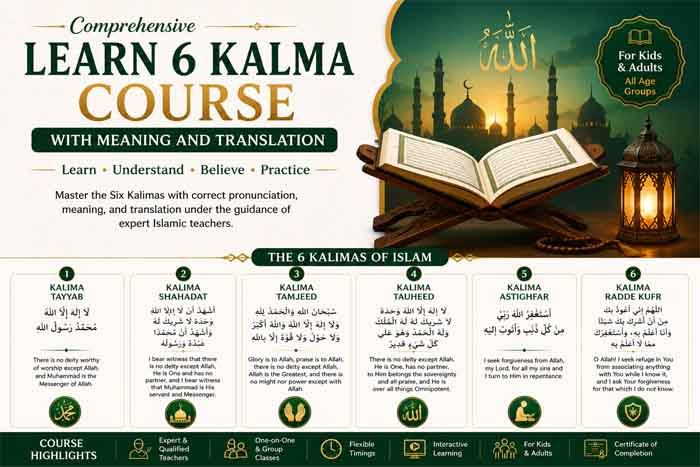
Introduction
Islam is a religion built upon foundational beliefs that shape the way Muslims understand their faith, their relationship with Allah, and their daily conduct. Among the most essential elements of Islamic teaching are the Six Kalimas, which serve as concise yet profound declarations of faith covering core beliefs such as the oneness of Allah, the prophethood of Muhammad (peace be upon him), repentance, rejection of disbelief, Interactive Learn 6 Kalma Course with Daily Practice and unwavering devotion. For many Muslims, especially children and new learners, memorizing and understanding these Kalimas forms one of the earliest and most important steps in religious education. A comprehensive Kalma course designed with meaning and translation allows learners not only to recite these sacred words correctly but also to genuinely understand their significance, transforming memorization into meaningful spiritual practice rather than mere repetition without comprehension.
The Significance of Learning the Six Kalimas
The Six Kalimas are far more than simple phrases to be memorized; they encapsulate the core tenets of Islamic belief and serve as a spiritual foundation for every practicing Muslim. Each Kalima addresses a distinct aspect of faith, ranging from affirming the oneness of Allah to seeking forgiveness and rejecting disbelief in all its forms. Learning these declarations with proper understanding helps believers internalize their meaning rather than treating them as words to be recited without reflection. This depth of understanding becomes particularly important for younger learners, who benefit immensely from structured lessons that explain not just what the words are, but why they matter and how they connect to broader Islamic teachings. A well-designed course recognizes this need and builds a learning experience that nurtures both memorization and genuine comprehension simultaneously.
Why Translation and Meaning Matter?
Many traditional methods of teaching the Kalimas focus heavily on rote memorization, where students repeat Arabic phrases without necessarily understanding their meaning. While memorization remains important, especially for correct pronunciation and recitation during prayers and religious occasions, understanding the translation adds a layer of depth that transforms the learning experience entirely. When students understand what they are saying, their recitation becomes an act of genuine reflection and conviction rather than an automatic, mechanical exercise. This is particularly valuable for children growing up in non-Arabic speaking households, where the meaning behind sacred words might otherwise remain unclear despite years of repetition. A course structured around Kalma meaning and translation ensures that learners develop a heartfelt connection to their faith, appreciating the weight and significance of each declaration rather than simply reciting memorized syllables.
Structure of a Comprehensive Kalma Course
An effective Kalma course typically follows a structured progression, introducing each Kalima individually before connecting them to broader Islamic concepts. Lessons often begin with proper pronunciation, ensuring learners can recite the Arabic text accurately, followed by a breakdown of each word's meaning and how those individual meanings combine to form the complete declaration. This gradual approach prevents overwhelming students with too much information at once, allowing them to build confidence with one Kalima before progressing to the next. Many courses also incorporate historical and contextual background, explaining the circumstances or significance behind why each Kalima holds the particular meaning it does within Islamic tradition. This structured methodology ensures that learners of varying ages and backgrounds can follow along comfortably, building a solid foundation before advancing to more complex religious concepts.
The First Kalima: Tayyab
The First Kalima, often referred to as Kalima Tayyab, represents the fundamental declaration of faith in Islam, affirming the oneness of Allah and the prophethood of Muhammad (peace be upon him). This Kalima forms the basis of the Shahada, the testimony that distinguishes a believer's acceptance of Islamic monotheism. Teaching this Kalima involves not just memorizing the Arabic text but helping students understand the Learn 6 Kalma Course with Arabic Pronunciation and Translation profound theological weight behind affirming that there is no deity worthy of worship except Allah, and that Muhammad is His final messenger. This foundational belief shapes every other aspect of Islamic practice, making it essential that learners grasp its significance early in their religious education, as it forms the conceptual framework upon which all subsequent teachings are built.
The Second Kalima: Shahadat
The Second Kalima, known as Kalima Shahadat, expands upon the declaration of faith found in the first Kalima by adding additional affirmations regarding Allah's attributes and the prophethood of Muhammad (peace be upon him). This Kalima reinforces the believer's testimony, emphasizing both verbal declaration and inner conviction as essential components of genuine faith. When teaching this Kalima, instructors often explain how testimony in Islam requires sincerity, meaning that the words must reflect a believer's true inner belief rather than serving as empty recitation. Understanding this connection between spoken declaration and heartfelt conviction helps students appreciate why the Shahada holds such central importance within Islamic practice, serving as both a personal affirmation and a public testimony of one's faith.
The Third Kalima: Tamjeed
The Third Kalima, called Kalima Tamjeed, focuses on glorifying Allah through praise and acknowledgment of His greatness, while also seeking refuge from sin and shortcomings. This Kalima emphasizes humility before Allah, recognizing human imperfection while simultaneously expressing gratitude and reverence toward the Creator. Teaching this particular Kalima often involves discussions about the balance between confidence in one's faith and humility regarding personal flaws, helping students understand that genuine devotion includes both praise for Allah's greatness and acknowledgment of human limitations. This dual aspect makes the Third Kalima particularly valuable for character development, as it encourages learners to approach their faith with both reverence and honest self-reflection rather than arrogance or complacency.
0 Comments