


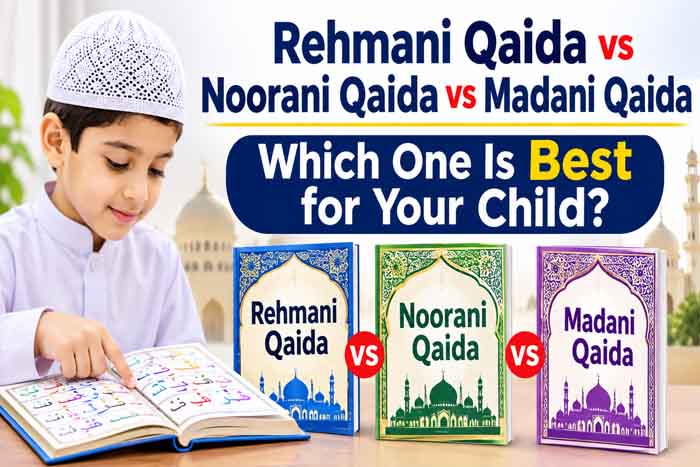
Which One Is Best for Your Child?
Every parent in Pakistan faces the same question when their child is ready to start Quran reading. One relative says "start with Noorani Qaida." A neighbour recommends Madani Qaida. The teacher at your local madrasa suggests Rehmani Qaida. All three sound right, all three are trusted, and all three promise to help your child read the Quran correctly. So which one should you actually choose?
The honest answer is that there is no single winner for every child. The right choice depends on your child's age, learning style and, most importantly, the teacher who will guide them. In this guide, we compare the three most popular beginner Qaidas in simple language, explain who each one suits and help you make a confident decision. We also explain what to look for if you want the best Rehmani Qaida in Pakistan for your family.
What Is a Qaida, and Why Does It Matter So Much?
A Qaida is a foundational book that teaches a beginner how to read Arabic script. It begins with individual letters, moves on to vowel marks and the joining of letters, and gradually builds up to reading full words. Only after completing a Qaida does a student move on to reading the Quran with Tajweed.
This first step is more important than most parents realise. A child who learns the letters and their pronunciation correctly at the beginning will read the Quran fluently for life. A child who learns with mistakes often has to unlearn them later, which takes far more time and patience. This is why choosing the right book and the right teacher matters more than choosing the fastest course.
A Quick Overview of the Three Qaidas
All three Qaidas share one goal: to take a beginner from "I cannot read Arabic" to "I can read the Quran." They follow a similar journey but differ in layout, teaching style and pace.
Noorani Qaida
Noorani Qaida is the most widely recognised beginner book across Pakistan and the Muslim world. Its simple, classic structure and the huge number of trained teachers make it a familiar choice for many families. Many parents choose it because they learned from it themselves.
Madani Qaida
Madani Qaida is also very popular, especially among families who follow its tradition. It is known for clear presentation and a gradual build-up of reading skills. Many children find its pages easy to follow.
Rehmani Qaida
Rehmani Qaida is a well-organised beginner book praised by many teachers for its systematic lessons and careful attention to pronunciation. It introduces letters, vowel marks and reading rules in a logical order, with plenty of practice so that children gain confidence before moving ahead. Because of this structure, it is a favourite among teachers who want students to master every step instead of rushing. A professional Rehmani Qaida in Pakistan is usually taught by a qualified teacher who follows this step-by-step method with patience.
Rehmani vs Noorani vs Madani Qaida: Side-by-Side Comparison
Here is a simple way to compare them. The exact content can vary slightly between editions and teaching styles, so use this as a general guide.
- Goal: All three teach Arabic letters, vowel marks, joining of letters and basic reading rules.
- Structure: Rehmani Qaida is known for its organised, lesson-by-lesson progression with regular practice. Noorani Qaida is known for its simple, classic layout. Madani Qaida is known for its clear, gradual presentation.
- Popularity: Noorani Qaida is the most widely recognised. Rehmani and Madani Qaida are strong choices in many communities.
- Teacher availability: Noorani teachers are the easiest to find locally. Qualified Rehmani and Madani teachers are also widely available, especially online.
- Best suited for: Noorani suits families who want the most familiar path. Madani suits families who follow that tradition. Rehmani suits children who benefit from structured practice and careful, step-by-step mastery.
The key insight is that the book matters, but the teacher matters even more. A patient, qualified teacher can make any of these three Qaidas work beautifully. A rushed or untrained teacher can make even the finest Qaida frustrating for a child.
How to Choose the Right Qaida for Your Child ?
1. Consider Your Child's Age
Children between 4 and 7 years old need short, repetitive lessons with lots of encouragement. A structured book with regular revision, like Rehmani Qaida, works very well here. Older children and adults often progress quickly and may be comfortable with any of the three, as long as the teacher explains the rules clearly.
2. Think About Your Child's Learning Style
Some children enjoy repetition and learn best through practice. Others get bored quickly and need variety. Watch how your child reacts in a trial class. If they stay engaged and can repeat the sounds correctly, the book and teacher are a good match.
3. Check the Teacher's Qualification
Ask whether the teacher is trained in Tajweed and has experience teaching children. Correct pronunciation of similar-sounding letters is the most valuable skill a Qaida teacher provides.
4. Follow Your Family and Community Tradition
If your family, mosque or community follows one particular Qaida, there is value in staying consistent. Your child can practise with siblings and relatives, and parents can support revision at home.
5. Look at the Language of Instruction
Children learn fastest when the teacher explains in a language they understand. In Pakistan, many parents prefer teachers who can explain in Urdu while also using clear Arabic pronunciation.
6. Always Book a Trial Class
The best way to decide is to see your child in a real lesson. A free trial lets you observe the teaching style, the pace and your child's comfort level before you commit.
Why More Pakistani Parents Choose Rehmani Qaida ?
Online Quran learning has changed how families approach the Qaida. Instead of travelling to a mosque or academy every day, children can now learn from home with a qualified one-to-one teacher. In this setting, a well-structured book helps both teacher and student stay on track.
Parents who choose the best Rehmani Qaida in Pakistan usually mention these advantages:
- Clear progression: Lessons follow a logical order, so parents can easily see what is completed and what comes next.
- Focus on correct pronunciation: Careful practice of letter sounds helps children avoid common mistakes early.
- Built-in revision: Regular practice helps children remember what they learned instead of forgetting it after a few days.
- Confidence building: Children move forward only after they are comfortable, which reduces frustration and fear.
- Suitable for different ages: The structured approach works for young children and also for adult beginners.
What Makes a Top Rehmani Qaida Course?
Not every class is equal. When you compare options, look for these features to find a top Rehmani Qaida course that delivers real results.
- One-to-one live classes: Personal attention allows the teacher to correct every mistake instantly. Large group classes make this difficult for beginners.
- Qualified male and female teachers: Families should be able to choose the teacher they feel most comfortable with, especially for young girls and boys.
- Flexible timings: Classes should fit around school, tuition and family routines.
- A free trial class: You should be able to test the quality before paying anything.
- Regular progress updates: Parents should know how their child is progressing and what to practise at home.
- Affordable and transparent pricing: Fees should be clear, with no hidden charges.
- Reliable technology: A stable video platform, a digital whiteboard and screen sharing make online lessons effective.
At ParhQuran, for example, students can learn with qualified male or female tutors in one-to-one sessions, with flexible class timings and a free trial class to experience the teaching quality before enrolling. This kind of setup gives children the personal attention that a Qaida requires.
What a Professional Rehmani Qaida Lesson Looks Like ?
Parents often wonder what actually happens inside a class. A professional Rehmani Qaida in Pakistan usually follows a clear routine:
- Warm-up and revision: The teacher reviews the previous lesson so that nothing is forgotten.
- New lesson introduction: The teacher introduces the new letters or rules slowly and clearly.
- Listen and repeat: The student repeats after the teacher, focusing on correct sounds.
- Individual reading: The student reads aloud while the teacher corrects every mistake.
- Practice and homework: A short practice task is given for the next day.
- Feedback: The teacher explains what went well and what needs more attention.
This predictable routine helps children feel safe and prepared. They know what to expect, which builds both skill and confidence.
How Long Does Each Qaida Take?
Parents often ask how long a Qaida takes to complete. The answer depends on your child's age, consistency and the number of classes per week. In general, most children finish a Qaida in a few months when they attend regularly and practise daily. Younger children may need more time, while older children and adults often progress faster.
Avoid choosing a Qaida only because it promises the quickest completion. Speed without understanding leads to weak reading. A steady pace, with correct pronunciation at every stage, always produces better long-term results.
Common Mistakes Parents Make When Choosing a Qaida
- Choosing only by popularity. The most famous book is not automatically the best fit for your child.
- Ignoring the teacher. A great teacher with any Qaida beats a weak teacher with a famous one.
- Switching books too often. Changing Qaidas every few weeks confuses children. Pick one and stay consistent.
- Rushing the process. Moving ahead before a lesson is mastered creates gaps that appear later.
- Skipping home practice. Even 10 to 15 minutes a day makes a big difference.
- Not attending a trial class. Without a trial, you are guessing instead of observing.
Tips to Help Your Child Succeed at Home
- Set a fixed routine. Children learn best when practice happens at the same time every day.
- Create a quiet space. A calm corner with a stable internet connection helps focus.
- Praise small wins. Celebrate every new letter or lesson completed.
- Listen to their reading. Even if you do not know Arabic, your attention motivates them.
- Keep sessions short. Short, focused practice is better than long, tiring sessions.
- Stay in touch with the teacher. Ask what to practise before the next class.
Which Qaida Should You Choose? A Simple Decision Guide ?
- Choose Noorani Qaida if your family prefers the most familiar and widely used path, or if your community follows it.
- Choose Madani Qaida if your family follows that tradition or your child responds well to its presentation.
- Choose Rehmani Qaida if you want a structured, practice-focused approach with careful progression, especially for young children or beginners who need extra confidence.
If you are still undecided, book a free trial and let your child experience a short lesson. Their reaction will tell you more than any comparison chart.
Final Thoughts: The Best Qaida Is the One Your Child Enjoys and Completes
Rehmani Qaida, Noorani Qaida and Madani Qaida are all trusted foundations for Quran reading. Each has helped countless children and adults read the Quran correctly. The difference is not about which book is right or wrong, but about which one fits your child, your family and your teacher.
Focus on three things: a qualified teacher, correct pronunciation and a consistent routine. When these are in place, your child will move from the first letter to confident Quran reading with joy instead of pressure. If you want a gentle and structured start, look for the best Rehmani Qaida in Pakistan with a caring one-to-one tutor, compare a few options and choose a top Rehmani Qaida course that offers a free trial. Book a class, watch how your child responds and begin this beautiful journey with confidence.
Frequently Asked Questions (FAQs)
1. What is the difference between Rehmani Qaida, Noorani Qaida and Madani Qaida?
All three teach Arabic letters, vowel marks and basic reading rules. They differ mainly in layout, teaching style and pace. The best choice depends on your child's age, learning style and teacher.
2. Which Qaida is best for young children?
Young children usually do well with a structured Qaida that includes regular practice and revision, such as Rehmani Qaida, provided the teacher is patient and uses short, engaging lessons.
3. How can I find the best Rehmani Qaida in Pakistan?
Look for qualified teachers, one-to-one live classes, flexible timings, a free trial class and transparent pricing. Reading parent reviews and observing a trial lesson are the best ways to judge quality.
4. Is Rehmani Qaida suitable for adults?
Yes. Adults who want to start reading the Quran can learn from the same structured lessons. Adult learners often progress faster because they understand rules quickly, and they benefit from private one-to-one classes.
5. How long does it take to finish a Qaida?
Most students complete a Qaida in a few months with regular classes and daily practice. The exact time depends on age, consistency and how many classes are taken each week.
6. Should my child switch from one Qaida to another?
Generally, it is better to stay with one Qaida and one teacher until it is completed. Switching often can confuse children and slow progress. If your child is struggling, first discuss teaching methods with the teacher.
7. What should I look for in a top Rehmani Qaida course?
A top Rehmani Qaida course offers qualified teachers with Tajweed knowledge, one-to-one attention, flexible timings, regular progress updates and a free trial class so that you can check quality before enrolling.
8. Is a professional Rehmani Qaida class affordable in Pakistan?
Yes. Many academies offer budget-friendly monthly packages with one-to-one classes. Compare what is included, such as class duration, weekly schedule and trial classes, to find the best value for your family.
0 Comments